Topic: Stock Market

Stock Market comes up in 15 chapters across 13 episodes of The Higherside Chats Free Show, from January 2015 to June 2026.

January 2015 June 2026

Related topics

Dave Collum | Uncomfortable Truths, Satanic Trafficking Networks, & Cutout Characters
• 34:55 - 39:00

Dave Collum | Uncomfortable Truths, Satanic Trafficking Networks, & Cutout Characters

SpaceX IPO, Market Liquidity and Potential Economic Crash

Dave Colum analyzes the potential impact of a SpaceX IPO on the broader stock market, comparing it to the end of the dot-com bubble. He argues that massive IPOs from companies like SpaceX and OpenAI could suck necessary liquidity out of the market, leading to a significant correction. Colum criticizes the high revenue-to-sales ratios of these tech giants as unsustainable and indicative of a market peak.

Alex Fulton | Cryptokubrology, Movie Magic, & Subliminal Bears
• 2:09 - 7:17

Alex Fulton | Cryptokubrology, Movie Magic, & Subliminal Bears

Technical Analysis of Synchronicity, Time as an Ordering Principle

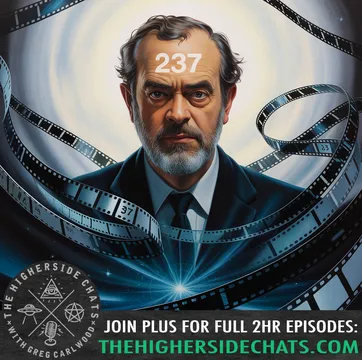
Alex Fulton explains the methodology of Crypto-Kubrology as a technical analysis of synchronicity, comparing it to technical analysis in the stock market where one focuses on price charts rather than fundamentals. He emphasizes that the timing of an event is as significant as the event itself, suggesting a temporal ordering principle in reality. Fulton reflects on his decade of research with Sean Montgomery, involving over 4,000 emails analyzing numerical patterns in film and real life.

synchronicitytechnical analysistemporal algorithmsean montgomerymark leclairdatastock market
Texas Slim | The Beef Initiative, Food Intelligence, & Getting Ahead Of The Coming Crisis
• 1:16:38 - 1:18:19

Texas Slim | The Beef Initiative, Food Intelligence, & Getting Ahead Of The Coming Crisis

Beyond Meat Stock Collapse, Impossible Foods and Death Spirals

Carlwood discusses the financial struggles of Beyond Meat and the failure of its partnerships with major fast-food chains like McDonald's. He references a quote from the CEO of Impossible Foods regarding a "death spiral" for red meat producers, celebrating the current market setbacks for fake meat companies.

Ras Ben | Yellow Fever: America’s First Plandemic & The Cycles Of Time
• 36:39 - 41:28

Ras Ben | Yellow Fever: America’s First Plandemic & The Cycles Of Time

Girard's Acquisition of the First Bank of the United States

Stephen Girard utilized the 1793 market crash to increase his holdings in the First Bank of the United States. By 1802, in collaboration with Napoleon Bonaparte, Girard reportedly betrayed Haitian leader Toussaint Louverture, kidnapping him and confiscating millions in wealth. This capital allowed Girard to become the majority stakeholder in the national bank, effectively owning the country's debt and renaming the institution "Citizens Bank."

first bank of the united statesstephen girardnapoleon bonapartetoussaint louverturebankingstock market
Jake Steiner | Ending Myopia, The Deceptive Eye Care Industry, & Active Focus
• 44:53 - 46:32

Jake Steiner | Ending Myopia, The Deceptive Eye Care Industry, & Active Focus

Stock Trading Background and Vanity Motivations

Steiner reveals that his initial motivation for fixing his eyes was vanity, as he disliked how thick lenses made his eyes look small. His background as a stock trader made him naturally skeptical of industry hype and skilled at identifying market deceptions, which he applied to his investigation of the optometry industry.

stock tradervanityresearch projectdeceptionmarket analysis
Ernst Willem Van Den Bergh | True Consciousness & The Science of Tesla’s Magic
• 4:26 - 6:25

Ernst Willem Van Den Bergh | True Consciousness & The Science of Tesla’s Magic

Artificial Intelligence Research, JP Morgan and Wardenclyffe Discovery

Ernst Wilhelm Vandenberg describes how his background in IT and artificial intelligence led him to discover Nikola Tesla's work. While developing AI programs to analyze the stock market and large gold transactions, he identified the role of JP Morgan in the gold market, which eventually led him to investigate the history of the Wardenclyffe Tower.

Ellen Brown | The Broken Economy & The Public Banking Solution
• 52:36 - 55:11

Ellen Brown | The Broken Economy & The Public Banking Solution

Financial Transactions Tax and Two-Tiered Systems

A 0.1% tax on financial transactions is proposed to capture revenue from high-frequency program traders without burdening average long-term investors. Currently, essential consumer goods are taxed while speculative financial trades often escape similar levies, creating a two-tiered system that favors the wealthy. This tax could generate significant revenue given that trillions of dollars are traded daily in the U.S. financial markets.

financial transactions taxhigh-frequency tradingstock marketsales taxinequality
Russell Targ & Lance Mungia | Third Eye Spies, Remote Viewing, SRI, & The CIA
• 1:11:08 - 1:13:32

Russell Targ & Lance Mungia | Third Eye Spies, Remote Viewing, SRI, & The CIA

Plus Member Content and Future Topics

The second hour of the podcast for Plus members covers topics such as using remote viewing for stock market forecasting, Targ's ESP training app, and a NASA conference involving Wernher von Braun. Carlwood concludes by thanking the guests and encouraging listeners to support the show through the subscription service.

Jeff Berwick | Hacking A Broken System, The Shemitah Cycle & The Jubilee Year
• 31:53 - 35:01

Jeff Berwick | Hacking A Broken System, The Shemitah Cycle & The Jubilee Year

Jonathan Cahn, 9/11, and the Shemitah Cycle

Jonathan Cahn’s book *The Harbinger* identifies biblical correlations between the Shemitah cycle and major historical events like 9/11. The Shemitah is a seven-year cycle from the Torah that mandates a year of rest, which Cahn links to massive market crashes. Notable examples include the crashes on September 17, 2001, and September 29, 2008, both occurring on the end day of the Shemitah year.

jonathan cahnthe harbingershemitah9/11stock market crash
Jeff Berwick | Hacking A Broken System, The Shemitah Cycle & The Jubilee Year
• 35:02 - 37:34

Jeff Berwick | Hacking A Broken System, The Shemitah Cycle & The Jubilee Year

September 2015 Global Market Meltdown and Shemitah Predictions

In late 2015, the global markets experienced a significant meltdown within weeks of the Shemitah end date, including a 50% drop in the Chinese stock market. During this period, "Shemitah" became one of the top search terms on Google as investors looked for explanations for the volatility. While a total collapse did not occur on the specific Sunday end date, the surrounding months saw record-breaking intraday losses for the Dow Jones.

september 2015chinese stock marketdow jonesmarket volatilitygoogle search
Jeff Berwick | Hacking A Broken System, The Shemitah Cycle & The Jubilee Year
• 45:12 - 46:43

Jeff Berwick | Hacking A Broken System, The Shemitah Cycle & The Jubilee Year

Brexit Numerology and the Seven-Year Cycle

The market reaction following the Brexit vote occurred exactly 7 years, 7 months, 7 weeks, and 7 days after the 2008 Shemitah crash. This mathematical alignment reinforces the theory of a structured seven-year cycle governing global financial markets. Analysts suggest that the current system is mathematically unsustainable, making a major crash inevitable regardless of the specific timing.

brexitnumerologystock marketseven year cyclesept 2008
John Hamer | The History of Bankster Control & Their Orchestrated Events
• 57:32 - 1:01:44

John Hamer | The History of Bankster Control & Their Orchestrated Events

Great Depression, Stock Market Manipulation and Dust Bowl

The Great Depression was a planned "plug-pulling" event where bankers first encouraged public investment in the 1920s before abruptly restricting credit in 1929. This orchestrated crash allowed the elite to buy up farms, businesses, and homes for pennies on the dollar after the public was made penniless. The resulting Dust Bowl and mass migrations were the direct consequences of this wealth extraction cycle, which the media falsely portrays as a natural economic phenomenon.

great depression1929 stock market crashboom and bustdust bowlasset seizurecredit restrictionforeclosure
Ole Dammegard | Problems With Paris and San Bernardino: False Flags and Faux Terror
• 40:13 - 42:33

Ole Dammegard | Problems With Paris and San Bernardino: False Flags and Faux Terror

Intelligence Summits, Stock Market Manipulation and Insider Trading

A high-level intelligence panel featuring CIA Director John Brennan and former MI6 Chief John Sawyers took place shortly before the Paris attacks. Dammegard suggests these events are timed for Friday evenings to allow for three days of closed markets, facilitating massive insider trading. He claims similar financial anomalies occurred during the assassinations of JFK and Olof Palme.

Ole Dammegard | False Flags, The Caravan of Crisis Actors, & Their Global Terror Tour
• 25:40 - 27:15

Ole Dammegard | False Flags, The Caravan of Crisis Actors, & Their Global Terror Tour

Stock Market Manipulation and Friday Event Timing

The discussion explores the correlation between major assassinations and stock market fluctuations, citing the deaths of JFK and Olof Palme. Demingard posits that events are often timed for Friday afternoons to allow insiders to fix currencies and trades over the weekend. This timing ensures maximum profit when markets reopen on Monday morning.

Jen Briney | The Corporate Control Of Congress, The Federal Budget, & Privatization Propaganda
• 51:14 - 54:26

Jen Briney | The Corporate Control Of Congress, The Federal Budget, & Privatization Propaganda

Minimum Wage Debates, Walmart Subsidies and Economic Theory

Arguments for eliminating the minimum wage are dismissed as a race to the bottom that benefits only stockholders. Briney points out that companies like Walmart effectively receive government subsidies when their employees require public assistance to survive. She characterizes "free market" proponents as having a religious-like devotion to a theory that has no successful real-world examples, arguing that rules are necessary for a moral society.

minimum wagewalmartpublic assistanceliving wagestock market