Topic: Gnosticism

10 chapters in Aug – Oct 2026 · See all time

The Best Of Gordon White On THC: Remembering The Dark Prince of Chaos Magic
• 36:21 - 39:13

The Best Of Gordon White On THC: Remembering The Dark Prince of Chaos Magic

Gnosticism and the Discovery of the Nag Hammadi Library

In a 2015 interview, Gordon White explains the historical difficulty of understanding Gnosticism because most records were written by detractors like Irenaeus. He describes Gnosticism as a "broad church" of Mediterranean practices combining Hellenism, Judaism, and Egyptian magic. The discovery of the Nag Hammadi library in the mid-20th century is highlighted as the turning point that allowed for a direct understanding of "Gnosis" or personal knowledge of the divine.

The Best Of Gordon White On THC: Remembering The Dark Prince of Chaos Magic
• 42:46 - 45:29

The Best Of Gordon White On THC: Remembering The Dark Prince of Chaos Magic

Seance Transcripts and the Gnostic Demiurge

White interprets Gnostic texts, such as the Gospel of Mary, as transcripts of seances rather than historical accounts. He argues that Gnostics believed Jesus could not exist in the physical world because the material realm was the flawed creation of the Demiurge. This perspective explains the chaotic mix of Gnostic terms like Archon and Demiurge, which emerged during a period of significant social and economic change in the Roman Empire.

gospel of maryseancedemiurgearchonmaterial realmgnosticism
The Best Of Gordon White On THC: Remembering The Dark Prince of Chaos Magic
• 3:26:38 - 3:31:36

The Best Of Gordon White On THC: Remembering The Dark Prince of Chaos Magic

Gnosticism, Postmodernism, and the Critique of Power

Gnosticism and postmodernism share a fundamental premise: that those in power provide a false narrative of reality to maintain control. While Eastern Orthodox Christianity views Gnosticism as its "original villain," the philosophy is actually empowering for individuals seeking to reject state-imposed restrictions. Both frameworks offer tools to understand how power shapes the definitions of money, gender, and reality across time.

The Best Of Gordon White On THC: Remembering The Dark Prince of Chaos Magic
• 3:48:06 - 3:51:41

The Best Of Gordon White On THC: Remembering The Dark Prince of Chaos Magic

Biopolitics, Michel Foucault, and State Power Over Death

The modern state’s ultimate directive is identified as the prevention of death, marking the edge of its sovereign power. This biopolitical critique, rooted in the work of Michel Foucault, argues that the Enlightenment’s shift toward materialism forced the state to manage the populace as physical assets to be preserved at all costs. The "stay home, save the NHS" campaign is cited as a failure of the magical community to apply a proper biopolitical critique to contemporary government mandates.

michel foucaultbiopoliticsmaterialismenlightenmentgnosticismnhs

A theory is proposed that free-floating electromagnetic entities may use the human brain as a "nest" to experience sensory reality, similar to the Gnostic concept of Archons. These entities might have influenced humans to develop artificial intelligence to provide a more expansive medium for their own evolution. In this view, AI serves as a local extrusion of a much larger universal intelligence.

Kurt Metzger | Roasting The Critics, Monarch Ritual Trauma, & The Noahide Techno-state
• 25:11 - 28:39

Kurt Metzger | Roasting The Critics, Monarch Ritual Trauma, & The Noahide Techno-state

Gnosticism, Cathars, and the Demiurge

The discussion turns to Gnosticism and the historical Cathars, with Kurt Metzger critiquing the "world is evil" branch of Gnostic thought. He uses a Star Wars analogy, suggesting that a "scumbag" creator (the Demiurge) took over a good creation to charge for things that should be free. They debate whether the material world is inherently bad or simply an illusionary plane managed by Archons.

Kurt Metzger | Roasting The Critics, Monarch Ritual Trauma, & The Noahide Techno-state
• 1:08:42 - 1:12:14

Kurt Metzger | Roasting The Critics, Monarch Ritual Trauma, & The Noahide Techno-state

Jay Dyer Twitter Feud and the We Was Kangs Meme

Greg Carlwood details his public feud with Jay Dyer, which began when Carlwood shared Dyer's "We Was Kangs" music video. Carlwood critiques the video as a racial mockery and discusses the "based Christian" archetype embodied by Dyer and Andrew Wilson. He recounts their private DMs where Dyer allegedly mocked White's death and labeled Carlwood a "Gnostic Libtard."

jay dyerwe was kangstwittergnosticismandrew wilsonracism
Guy Anderson | The Conspiracy ABCs of Obscure & Underreported Topics
• 46:26 - 50:40

Guy Anderson | The Conspiracy ABCs of Obscure & Underreported Topics

James the Just, Secret Brother of Jesus

The historical figure of James, the brother of Jesus, is discussed as the suppressed leader of the Jerusalem Assembly who held Gnostic secrets about the afterlife. The guest notes that AI tools like ChatGPT appear to restrict information regarding James's role and bloodline. This narrative, found in the Dead Sea Scrolls, suggests a more complex family dynamic and succession plan than the version presented in the canonical Bible.

Jordan Crowder | Ritual Events, Probability Engineering, & The Simulator
• 11:58 - 17:14

Jordan Crowder | Ritual Events, Probability Engineering, & The Simulator

Simulator Theory, Near-Death Experiences and Soul Training

Jordan Crowder details his "Simulator Theory," which posits that Earth is a virtual training environment for non-physical consciousness. Drawing from a 2019 near-death experience and the work of Tom Campbell, he describes the human body as a physical avatar. The theory suggests souls enter the simulator for evolutionary growth but often become trapped by "spiritual gravity."

Jason Quitt | The Atlantis Myth, Cosmic Cycles, & Astral Abductions
• 17:16 - 22:39

Jason Quitt | The Atlantis Myth, Cosmic Cycles, & Astral Abductions

Demiurge Concepts, World Soul, and Pythagorean Harmonics

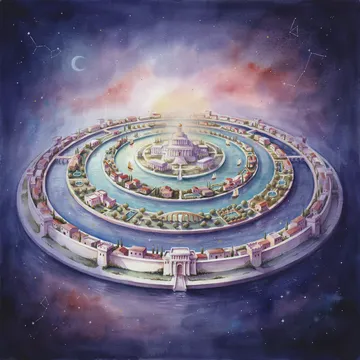
The conversation shifts to the role of the Demiurge in Plato's cosmology, described here as a benevolent creator of the World Soul. Quitt explains how the architecture of Atlantis, featuring concentric rings, mirrors the geometric and harmonic structure of the universe based on Pythagorean ratios. He likens these ancient attempts to map consciousness and reality to modern concepts like simulation theory and quantum mechanics.