Friday, 25 September 2026

Mark Booth | Mystic Scientists, Strange Happenings, & The Secret History Of The Universe

The hidden history of the universe emerges as a tapestry of alchemical secrets, quantum entanglement, and the mystical experiences of the world’s most famous scientists.

Secret HistoryIsaac NewtonQuantum MysticismWolfgang PauliArchon TheoryCarl JungAlchemical Science
By The Higherside Chats Free Show | 1h 13m listen | 29 chapters
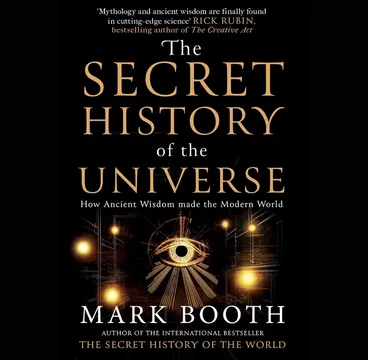
Mark Booth | Mystic Scientists, Strange Happenings, & The Secret History Of The Universe cover

About this episode

Author Mark Booth, writing under the pseudonym Jonathan Black, challenges the rigid materialism of modern academia by exposing the occult foundations of the world’s most celebrated scientific minds. Isaac Newton, famously dubbed the last of the magicians by Maynard Keynes, maintained a private life steeped in alchemy and hermeticism that directly informed his laws of motion. This hidden history reveals that the pioneers of quantum mechanics, including Werner Heisenberg and Erwin Schrödinger, frequently turned to Rosicrucianism and the Kabbalah to model the behavior of subatomic particles.

Wolfgang Pauli experienced the psychokinetic Pauli Effect, a phenomenon where laboratory equipment shattered in his presence, leading him to collaborate with Carl Jung on the intersection of physics and the psyche. These historical accounts intersect with modern anomalies like the Jim Twins case and the legend of the Green Children of Woolpit to suggest that consciousness is not a biological accident but a fundamental property of the cosmos. Inventors such as Alexander Graham Bell, Thomas Edison, and Marie Curie actively pursued spiritualism, viewing the seance room as a legitimate laboratory for investigating the unseen forces that govern physical reality.

Mark Booth recounts a childhood encounter with a hovering metallic entity and discusses the fine structure constant, 137, as a mathematical bridge between the material and the divine. Greg Carlwood critiques the secular cult of personality surrounding Albert Einstein and the limitations of reactionary atheism in the face of indigenous animism. The conversation concludes with an analysis of the Gnostic Archon theory, suggesting that artificial intelligence may serve as a parasitic nest for electromagnetic entities seeking to influence human evolution.


CHAPTER 01 / 29 Discussion

Higherside Chats Plus Seven-Day Free Trial Offer

Host Greg Carlwood introduces a new episode of The Higherside Chats, emphasizing its independence from outside sponsors and networks. A seven-day free trial for the THC Plus membership is currently available without requiring a credit card. Subscribers gain access to the full two-hour show and an extensive archive of extended interviews dating back to 2010.

higherside chats· thc plus· free trial· podcast archive· greg carlwood

00:00 Well, here goes nothing with another new episode of THC, truly independent of any outside sponsors, networks, agents, or conflicts of interest of any kind. I've got no strings on me. As always, the first hour is free, and the full two-hour show is for Plus members. And can you believe it? Right now, you can get a seven-day free trial at THC Plus, and it doesn't even require you to put in a credit card. Just grab the link from the show notes or that QR code if you're watching on YouTube. It'll take you to the higher sidechats.com. Put in only your email address, and I'll send you a username and password to access the full archive of extended interviews and bonus shows going back to 2010. You can hear more about it after the show. There's other details and all that stuff. Lots of wild taboo material to be dug up in there. Don't say I didn't warn you. Enjoy.

CHAPTER 02 / 29 Discussion

Mark Booth and Secret History of the Universe

Author Mark Booth, also known by the pseudonym Jonathan Black, returns to the program to discuss his latest work, The Secret History of the Universe. The discussion centers on the outdated dichotomy between science and spirituality, arguing that many foundational scientific breakthroughs were driven by mystical experiences. Booth has previously authored global bestsellers including The Secret History of the World and The Sacred History.

mark booth· jonathan black· secret history of the universe· sacred history· materialism· mysticism

00:50 It's the end of the world as we know it, but I feel fine. From the Sunshine State, I'm Greg Carlwood. And we've been conditioned to believe that any serious, well-educated, logical person must dismiss silly things like the spiritual, the paranormal, and the Fordian. But dig a little deeper throughout our history. And many academics and scientists have quietly considered their own personal experiences with the highly strange to have been a driving force in their scientific work, or maybe even responsible for their biggest breakthroughs. The reality is that ancient mystics were in a lot of ways scientists of their day, and many modern scientists are more mystic than they appear. The presentation we're given, though, is that you must choose one: superstition or serious knowledge-seeking, spirit or science.

01:32 It's an outdated dichotomy that needs to go away and really never should have been. Spirit, consciousness, and the unseen world is not at war with science, but it isn't a fight to the death with materialism. And I usually bet on the truth winning out, though it sure likes to take its time. Well, these are the major thrusts I've been thinking about after reading the latest book from returning guest Mark Booth, aka Jonathan Black, a book titled The Secret History Of The Universe. It's hard to believe our last interview was 11 years ago in 2015, but we talked largely about his highly acclaimed global bestseller, The Secret History Of The Universe, and I remember it fondly.

02:08 He's also the author of The Secret History Of The Universe Mysteries of the Inferno, as well as The Sacred History: How Angels, Mystics, and Higher Intelligence Made Our World. I'm very happy to have him here again. The materialist model muckraker, unseen world revealer, and the secret history of everything. Author Mark Booth, welcome back. Thank you for having me, Greg. What a wonderful introduction. I really deserve it. Can I tell you why I have two names first? Yes, I imagine it's just a pseudonym that got out of control. Well, what happened is that I was working in publishing in London when I had the idea for The Secret History Of The Universe.

CHAPTER 03 / 29 Discussion

Publishing Challenges and the Jonathan Black Pseudonym

Mark Booth explains that he adopted the pen name Jonathan Black while working in the London publishing industry to protect his professional reputation. Every major publisher initially rejected his manuscript because it lacked a sales precedent and was deemed too unconventional. The book was eventually picked up by a new company whose founder had been searching for such a perspective for decades.

publishing industry· london· pen name· jonathan black· anonymity

02:57 I was worried that all my peers in my own publishing company and elsewhere would think I was nuts or that the book was utter rubbish and that my career would be completely destroyed. And so I asked him to use a pen name, Jonathan Black. And indeed, it was rejected by every single publisher in London. They did think it was rubbish. They thought it would never sell because it wasn't like any other book that had been published before. So there were no sales precedents, which is what the sales guys like, of course.

03:36 Of course, yes, yes. Then a new company started, and the head of it loved it and said, I've been looking for this book for decades. So that book just very narrowly squeezed through from the realm of ideas into the physical realm. But it might very easily not have happened. And I think that people in publishing, people who work in publishing, are often very complacent. And they say things like, well, if a script is good enough, it will always find a publisher.

04:12 I see no reason to believe that's true. No, no. I totally understand the tendency to want a little anonymity when releasing something controversial. It's how I ended up with a stage name myself, but this is what we do. And then it ends up working out. And then it's like, well, I guess that's just who I am now. But thank you for doing this. Thanks for telling me about your new book. It was a pleasure to read. Just so full of insightful, esoteric facts about many of the bright minds our modern models of reality are built on. I've heard you talk about the book previously, and you said that you really didn't have an interest in science.

CHAPTER 04 / 29 Discussion

Scientific Establishment and Secret Occult Interests

Despite the public-facing materialism of modern academic institutions, Mark Booth reveals that many high-level scientists, spies, and public figures maintain deep interests in the esoteric. He describes a specific professor at a top English university who leads magical ceremonies in a secret society while maintaining a traditional academic persona. This highlights a disconnect between the atheistic establishment and the private mystical lives of its members.

occultism· academia· secret societies· materialism· atheism

04:53 I'm kind of right there with you. But after Secret History Of The Universe came out, you were approached by a lot of scientists. who were often mystics and sometimes even practical occultists. Is that right? Well, that's right. Yeah, no, I hated science and physics at school when I was 16. Well, we have to take, we had to take some exams called O-levels, and I got grade four for physics, which is just one grade above fail. And I found it very boring. And yeah, after the secret history of the world was published, I didn't try to prove anything in the secret history of the world.

05:37 I just presented this picture of the cosmos and asked people if it resonated with their experience of life. And then, yeah, lots of different people got in touch with me. Rock stars and comedians and spies. I mean, spies love a good secret. But the most surprising were scientists, yes. And it resonated with them. And they told me that a lot of them have very well-developed interest in the esoteric and the occult.

06:21 And there's one professor I know who is at one of England's top universities. So every term he puts on his academic robes to mark the start of the term and takes part in ceremonies. Twice a year, he goes to a medieval castle in Europe and he puts on a different kind of robes. He puts on magical robes and he leads magical ceremonies in a secret society. So I have to be careful that he isn't identifiable because he would lose his job.

07:05 And lots of scientists have a very well-developed interest in this stuff. But the establishment is still very atheistic and materialistic. Yeah, it's kind of strange. Like it kind of goes with your whole story of wanting to write anonymously. Like these things are part of a lot of people's regular lives, but they can't open up about them or they feel they can't open up about them over this perception. But the perception, I don't know where it comes from, because it's, I guess, maybe the institutions themselves, but it doesn't seem to really

CHAPTER 05 / 29 Discussion

Isaac Newton and the Occult Roots of Quantum Physics

Isaac Newton is identified as a primary example of a scientist deeply embedded in alchemy, with economist Maynard Keynes famously labeling him the last of the magicians. Early 20th-century physicists like Heisenberg and Schrodinger turned to Indian mysticism, the Kabbalah, and Rosicrucianism to model the strange behaviors observed in the quantum realm. These pioneers used esoteric frameworks to understand particles popping in and out of existence and the influence of the observer on reality.

isaac newton· maynard keynes· quantum mechanics· alchemy· werner heisenberg· erwin schrodinger

07:45 be a thing. Because when you look at the history of science and all the major players who had impacts on science, and they mostly have a mystical worldview. I might not have been so confident saying that before reading your book, but man, it's like two dozen people who are the big players in developing this mathematics, developing this theory, all the things that are the building blocks, the Legos of our current concept of reality. And they all either had experiences or at least believed in the mystical. Well, yes, that's right. I mean, I think that everyone now knows that Isaac Newton had a big interest in the occult in alchemy.

08:28 And it was a famous economist called Maynard Keynes who discovered this cache of alchemical writings. He wrote more about alchemy than he did about science. And Maynard Keynes said Newton was the last of the magicians. But he was wrong because he was by no means the last. And if you look at the great scientists who drove science and physics at the beginning of the 20th century, they were all, well, they were all very well-educated men.

09:06 They all had a very well-developed interest in a passion for the occult. And I think that what happened was the reason why these ideas came into play is because when the technology developed so that they were able to see things on a smaller and smaller scale down in what became known as the quantum realm, they were seeing things which would count as supernatural if they happened in the realm of human affairs. So they saw particles popping in and out of existence all the time.

09:48 And that raises the question, where do they come from or where do they go to? They saw particles. particles going through a solid wall and coming out the other side like a ghost going through a wall. They saw particles coordinating their behavior, even if they were a very long way away and there was no causal connection between them. And they also saw that if you look at a particle, you can change its behavior just by looking at it. without doing anything to it. And that, of course, is resonant of psychokinesis.

10:24 So they were looking at these weird happenings and they realized that the old mechanical physics, which saw atoms as knocking into one another like billiard boards and it all being a very mechanical process, just couldn't begin to describe what they were seeing. And that is why they turned to their esoteric and occult interests to find new models of thought. And they were all very well versed in Indian mysticism. A lot of them were into the Kabbalah, because actually most of them were Jewish.

11:07 Schrodinger and Heisenberg were very interested in the Rosicrucian Brotherhood and that stream of esotericism. And it is by using those models of thought that they began to get to grips with the weird things that were happening. And also, as you mentioned, they needed to get into other states of consciousness. I think we've been conditioned to see the world in a certain rather narrow way in terms of three dimensions and time going steadily forward.

CHAPTER 06 / 29 Discussion

Altered States of Consciousness and Modern Conditioning

The discussion explores how modern society is engineered to keep individuals in a narrow "baseline consciousness" through the suppression of indigenous traditions and the stigmatization of meditation or astral travel. While foundational scientists often utilized drugs, spiritual exercises, or even bouts of madness to access new ideas, modern education strips these "messy" components from their official biographies. This creates a false perception of the universe as a purely mechanical system.

consciousness· meditation· astral travel· indigenous traditions· baseline consciousness

11:51 And that form of consciousness makes understanding these phenomena very hard. So a lot of them performed spiritual exercises to get into other states of consciousness. Some took drugs as an aid. Some of them went spontaneously mad and a few of them never made it back. Right. Always something to be wary of when you're going into altered states of consciousness. But yes, we have been conditioned to baseline consciousness, which, you know, it's because the dominant religions no longer contain the real potency that they maybe once did, or at least is still preserved within indigenous traditions.

12:38 You can't take the drugs legally. You can't buy them legally. So it takes a little extra effort. You know, meditation is not encouraged. Things like out-of-body experience and astral travel are kind of put in the realm of silliness. So it's actually a little hard to get out of baseline consciousness, even if you want to, especially with all the modern distractions. So it seems definitely intentional, definitely engineered, but it is just so rare to find one of these guys that actually feels that the world is just matter and the universe is mechanical.

13:14 And yet they make us believe that is the case. If you read, if you're in school, like you learn about these people and you learn about their contributions to the models, but they leave out all that other stuff. And you can't do that. A person should be considered in their totality. You shouldn't say, well, Niels Bohr and Schrodinger and Einstein, their contributions are important, but all the other components that we don't like, the messy stuff, we're going to leave that out. Like, I never really cared much for Freud, to be honest with you. And his contributions to psychiatry are just bizarre to me. I don't think everything should be reduced to sexual repression. It seems like that's his shit.

CHAPTER 07 / 29 Discussion

Sigmund Freud and Carl Jung Paranormal Experiences

A comparison is drawn between Sigmund Freud and Carl Jung regarding their engagement with the paranormal. While Freud experienced bizarre visions and hauntings—including a sighting of his own "shadow self"—he attempted to repress these events in favor of materialism. In contrast, Jung embraced his mystical experiences and background in seances, leading to a philosophy that has arguably remained more influential in modern spiritual circles.

sigmund freud· carl jung· psychoanalysis· shadow self· seances

13:59 And, you know, fine. But I didn't realize he had such a haunted life. Talk to us a little bit about some of his seemingly paranormal and bizarre experiences because there are many you could choose from. Yes. Well, he, he, um, I do, I have a little section where I compared the lives of Freud and Jung. And Freud had some very bizarre visions and dreams, a lot to do with his dead father. At one point, he saw an image of himself in a mirror.

14:37 He didn't realize, he didn't recognize immediately, but he later realized it was his shadow self he was looking at. he was all the time trying to repress this stuff. Whereas Jung, on the other hand, embraced it. And Jung was brought up in a household where they were holding seances all the time. And he too had mystical experiences. And he built that into a philosophy which is now extraordinarily influential in a way where I think that Freud's emphasis on his materialism has just

15:28 dropped away. I don't know how many practicing, there would be very few practicing Freudian psychoanalysts in England today, I would say. I think Jung has carried the day. So, yeah, I think, I mean, there have been books which try to reconcile new physics and spirituality. I think they, you know, there have been books about quantum healing and quantum spirituality. I think they've tended to be a bit vague. Yes. The physicist Richard Feynman, he had this phrase hand waving, when somebody was saying, oh, yeah, well, it's sort of like this.

CHAPTER 08 / 29 Discussion

Atomic Void and the Illusion of Solidity

Modern physics demonstrates that the material world is largely an illusion, as the nucleus of an atom is infinitesimally small compared to the surrounding void. The sensation of solidity when touching a table is actually the result of electromagnetic fields repelling one another rather than physical matter colliding. This reality suggests that higher dimensions, which inform and shape the three dimensions we perceive, may be more "real" than the physical world.

atoms· electromagnetic fields· albert einstein· dimensions· materialism

16:14 But they don't really know anything very precisely. And what I've tried to do in this book, I think there's about a hundred pages of notes at the back where these physicists are quoted talking about their interest in the esoteric and the occult. So I really tried to pin it down. I mean, it is weird that the establishment still clings to this extreme materialism because they know, for example, that objects that look solid to us are not really solid at all.

16:53 Because a nucleus of an atom in proportion to the whole is like a pee in the middle of a sports stadium. So a table that looks solid to us is a finer mist than the finest mist you can conceive of. And when we slam our fist on it, that impact is not, as I think I was taught at school. I don't know about you, I was taught that is atoms knocking against atoms. That's not what's happening. It's electromagnetic fields repelling one another. And science has known actually since the time of Einstein, and this is one of his great innovations, that there are other dimensions than the three we're familiar with, the three we perceive.

17:47 And these other dimensions sort of prop up the ones we see with our senses. They inform them and shape them. And that raises the question: how real are they? Because if the dimensions we perceive depend on them, then there is a sense that they're more real, that they have greater existence. So if you take a sentence like, does God exist? God is quite a slippery concept, isn't it? Because people have been thinking about what God is like for many millennia, and they come up with all sorts of different ways of describing God and different definitions and accounts of what he can do, or indeed

18:42 whether he exists or not. But in fact, the most slippery word in that sentence, does God exist, is exist. When we talk about these other dimensions existing, what do we mean? And that's an interesting question we could come back to if we get around to talking about visitations later on. Yes, I'm sure we'll get to visitations. But with Freud, a couple other notes I had is that, you know, from your book, he was deeply haunted by the number 62. It would eerily recur throughout his life. He would just notice this all the time: train tickets, hotel rooms, and hat checks stubbed.

CHAPTER 09 / 29 Discussion

Green Children of Woolpit and Underground Realms

The conversation shifts to the legend of the Green Children of Woolpit, two mysterious children who reportedly appeared in 12th-century England with green skin. They claimed to come from a sunless place called St. Martin's Land, leading to theories about underground civilizations or multi-dimensional phasing. Mark Booth suggests these events represent a literal intersection between different realms of existence.

green children of woolpit· st martins land· folklore· multi-dimensional· underground civilization

19:27 I think Wolfgang Pauli is the other one who had a number that would follow him through his life. And he actually died in a hotel room of that number. Yes. If I remember that. And then the book is just so densely filled with scientists who should never be concerned. considered materialists, but as well as some amazing stories, bizarre paranormal stories, Fordian things that illustrate that we don't know everything about our world. I was actually really surprised. It's been a long time since I picked up a book that contained the story of the green children of Walpit.

20:05 And it is in yours. It's one of my favorite stories ever, probably because it does involve the underground realms. That these kids who came up from underground were green and they actually had a name for where they came from, St. Martin's Land. And then the boy died, but the girls kept her alive and she married someone and she learned English, and that's how she told about where she came from. It's so bizarre. I don't. How do you make sense of that? Do you think there was a literal underground city these kids climbed through, or was this some kind of multi-dimensional phasing situation? And that's how they end. I think it was probably the latter, yeah. I mean, you mentioned Pauli.

CHAPTER 10 / 29 Discussion

Wolfgang Pauli and the Psychokinetic Pauli Effect

Physicist Wolfgang Pauli, a peer of Einstein, is described as having a "dark cloud of energy" that caused laboratory equipment and household objects to shatter in his presence. This phenomenon became known as the Pauli Effect, leading some Nobel Prize winners to ban him from their laboratories. Pauli’s personal struggles with guilt and depression eventually led him to seek therapy with Carl Jung, where they explored the intersection of physics and the psyche.

wolfgang pauli· psychokinesis· princeton institute· quantum physics· synchronicity

20:50 He is actually my favorite character in the whole book. And I would, oh, I would, I would have loved to have had him as a friend. You know, he was a very complex guy. Einstein called him his spiritual heir. He was the most intelligent physicist in the post-Einstein Niels Bohr generation. He was very cheeky when after Einstein gave a lecture, Pauli stood up, looked round at the audience, and said, Well, if you think about it, what Einstein is saying isn't so stupid.

21:28 And he was very quick with the put-downs. My favorite, when somebody was expounding a theory he thought was completely wrong, was that's not even wrong. I love that. But he was very kind of sparky and rude like that, but hypersensitive himself. And his mother committed suicide when she discovered that her husband, his father, was having an affair.

22:04 And Pauli had just written her a letter saying, I'm sorry, I'm a physicist, I'm a scientist, I'm a dry old stick, I can't love you as you ought to be loved. And of course, he felt terribly guilty about that. And he took to drinking a lot. He would go regularly into the red lights district looking for love. And he would get drunk quite a lot and get thrown out of nightclubs, getting quite badly beaten up on several occasions. And then he fell in love with a beautiful nightclub singer.

22:45 I imagine that she was a bit like Marlena Dietrich in The Blue Angel. I don't know if you know that film. It's one of my favorite films. No. He married her and took her back to the Princeton Institute of Advanced Studies, which is the greatest institution for the study of physics in the world. And she was very quickly unfaithful to him. He said, he said, well, I could have understood if it was a metador, but a chemist. And he just sank deeper and deeper into depression.

23:27 And he would find that this dark cloud of energy would rise up in him and begin to surround him. And when that happened, things in his vicinity would break and fall apart, including lab equipment. And one Nobel Prize-winning physicist banned Pauli from ever entering his lab because he thought there was a high probability he would wreck it. Vases would shatter in his presence. And it sounds crazy and it sounds laughable, but for him, it was very depressing.

CHAPTER 11 / 29 Discussion

Quantum Entanglement and Emotional Synchronicity

Erwin Schrodinger’s concept of quantum entanglement suggests that particles remain connected across vast distances, a theory that Einstein initially dismissed. Carl Jung and Wolfgang Pauli expanded this idea to human emotions, proposing that deep fears or desires could manifest as meaningful coincidences in the physical world. This framework provides a scientific basis for synchronicity, where the universe appears to respond to internal psychological states.

quantum entanglement· erwin schrodinger· synchronicity· carl jung· psychology

24:11 Sure, sure. That which drove him to go and visit Carl Gustav Jung in Switzerland and seek therapy. And Pauli and Jung found they were kindred spirits and they began to work together. And what they had in common was this interest in the occult. And at that time, Erwin Schrodinger had an idea about something he. he called quantum entanglement. And that's the thing I mentioned earlier, where two particles can coordinate their behavior, even if they don't seem to be connected.

24:53 And in the beginning, well, Einstein thought the whole idea was rubbish. He didn't believe it for a moment. People came to see that you could make it happen in the lab in very special circumstances. And then people, scientists, began to realize that, well, you know, well, perhaps it happens spontaneously and happens all the time. Perhaps this glass of whiskey isn't held in place just by my hand. Perhaps it's also held in place by particles on the far side of the universe to which it is attached

25:37 by this influence, which is like very long guy ropes. So everything is connected in ways that we hadn't understood before this new idea in quantum mechanics. And what Jung and Pauli began to think about was whether these connections might apply not just to particles, but to deep human emotions. Might it be the case that something we deeply desire or fear affects things out there in the world.

26:22 Yes, I agree with you. There's actually a lot of people in the medical space now folding in emotional states and things of that nature, feelings to things that cause physical manifestations in the body. It's being considered now more when it wasn't previously. And I think it probably makes sense. I'm just going to throw in your mention of the red light district in Pauli's story reminded me of probably the craziest Freud thing I had, which was on one occasion he was walking through an old Italian town and he accidentally wandered into their red light district, desperate trying to leave. Every single turn he took mysteriously led him straight back to the center of it as if he were trapped in a supernatural maze.

CHAPTER 12 / 29 Discussion

Jim Twins and Telepathic Connections

The "Jim Twins" case is cited as a potential real-world example of quantum entanglement between humans. Separated at birth and reunited at age 39, the twins shared identical names, pet names, car models, and even married and divorced women with the same names. The discussion posits that such phenomena, along with everyday mind reading and the intuitive "quality of silence" during phone calls, are common but often ignored due to social conditioning.

jim twins· quantum entanglement· telepathy· mind reading· coincidence

27:06 Now that seems like some shadow projection. I'm sure Jung would have something to say about that. But bizarre. On the subject of quantum entanglement, I wanted to ask you about this example you have in the book, The Jim Twins. Now, this is bizarre, and maybe quantum entanglement explains it, but these two guys are separated at birth in the 1940s and raised by entirely different families, miles apart. They were reunited for the first time at age 39. When they met, they discovered their lives had a terrifying series of parallels.

27:43 Both were named Jim by their adoptive parents. Both married women named Linda, then divorced them, then remarried women named Betty. Both named their sons James Allen. Both had a pet dog named Toy. Both drove Chevrolets, were heavy smokers and worked in law enforcement. And that's wild. Like you suggest that the best explanation for this is maybe they were joined through quantum entanglement. I mean, they were twins. And I'm open to that interpretation, but I guess if that's a mechanism, if that's a foundational part of how reality works, I wonder why examples that illustrate it are so rare.

28:28 I think it's because we're conditioned not to look at them. And I think that another thing that quantum entanglement explains would be mind reading. And I think we probably mind read all the time, but we're conditioned not to recognize it. And I think it's, you know, there are little ways we can test our ability to mind read. I think that if you telephone someone, and I don't know why, but the telephone is a mechanical advice device, which I think kind of intensifies this.

29:06 If you're telephoning someone and you ask them a very important question, and that might be, are the results of the test good? Or you might ask, do you still love me? There will be a pause or a silence before you get the answer. But I think that if you attend to the quality of that silence, you know what. what is going to be said. I think that makes sense. And Edison's another guy. Didn't Edison try to make a spirit phone? Didn't he believe that?

CHAPTER 13 / 29 Discussion

Spiritualism and Early Telephony Pioneers

Early inventors like Alexander Graham Bell and Thomas Edison were deeply involved in spiritualism and sought mechanical ways to communicate with the deceased. Marie Curie and her husband Pierre were also active spiritualists, viewing seances as a legitimate scientific frontier for investigating the supernatural. This historical context challenges the modern view of these figures as strictly secular materialists.

alexander graham bell· thomas edison· spiritualism· marie curie· spirit phone

29:45 Well, it was Alexander Graham Bell. Was it? I mean, Graham Bell, I know, invented the telephone, but I didn't think he also was the one who went to the spirit phone. Maybe he was. I think, well, I think that all those guys were at that time. I mean, I think that Alexander Graham Bell, you know, he was a spiritualist. He was into seances and he was looking for a scientific way to try and make these communications happen in a mechanical way. And, you know, I think we tend to look down our noses at spiritualism.

30:24 But at the time, it was science's attempt to get to grips with the supernatural and prove it. And Mary Curie, who is one of the greatest scientists in this story, and her husband Pierre and her lover Paul Langevin, they were all spiritualists. And it's anachronistic to look at them and try to impose the attitudes of the modern atheistic materialists on them. But just jumping back to Pauli and Jung,

CHAPTER 14 / 29 Discussion

Fine Structure Constant and Pauli Death

Wolfgang Pauli was obsessed with the number 137, which represents the fine structure constant necessary for matter to cohere. This number also holds significant meaning in the Kabbalah, representing a bridge between the physical and spiritual. In a final act of synchronicity, Pauli was admitted to hospital room 137 shortly before dying of pancreatic cancer, which he interpreted as a sign of the Kabbalah's validity.

fine structure constant· 137· kabbalah· pancreatic cancer· synchronicity

31:04 they called this idea of the connection between deep human feelings and what's happening out there synchronicity, which is a very big, very popular way of thinking in spiritual circles. And the point about synchronicity is that it's a meaningful connection. If you're driving along a road and three white Rolls-Royces go past you in the other direction, that probably just means that there's some kind of motor show in a field nearby.

31:42 So that's not particularly meaningful. But if you're driving along and a song comes on the radio that used to be your song with somebody you loved and you thought about getting in touch with them again, but you haven't really done it. And this song playing makes you do it, then that is a synchronicity. It's the universe trying to tell you something. It's saying, ring that girl. And Pauli experienced this, of course, with the number 137, which was the number that obsessed him.

32:23 One over 137 is the number of what's called the fine structure constant. And that is a proportion in material things, which if it was a tiny bit different, if it was one over 138, then matter wouldn't cohere and stick together and make shapes. We would just live in a universe of a sort of a soup without any lumps in it. So one over 137 is a key number in physics. And Pauli was fascinated with it because it's also a key number in the Kabbalah.

33:06 And when in his 50s, he suddenly felt a pain in his side, he was told he had pancreatic cancer and was lying in hospital. And he saw that the number of the room he was lying, dying in, was 137. That's what it was. There you go. That is synchronicity in action. The universe was trying to tell him something. It was telling him, you're going to die in a few minutes, but it was probably also telling him there is something more. The Kabbalah is right. There is something after death.

CHAPTER 15 / 29 Discussion

Evolution of Universal Models and Technology

Humanity’s understanding of the cosmos has historically mirrored the most advanced technology of the era, moving from the clockwork universe of the Enlightenment to the steam engine model of the Industrial Revolution. Today, the universe is increasingly viewed as a sophisticated computer or AI simulation. This shift suggests that information and ideas are more fundamental to reality than atoms or physical matter.

enlightenment· industrial revolution· artificial intelligence· simulation theory· cosmic mind

33:49 So you mentioned the question of, you know, what does it mean to exist? And we might talk about visitors. I was actually really compelled. I haven't read it, but your other book, The Sacred History, How Angels, Mystics, and Higher Intelligence Made Our World, I think it came out in 2017, a couple of years after our last interview. I mean, that seems really up my alley, but through the context of that book as well, what are your thoughts on visitors and the idea that you brought up? What does it mean to exist? Well, I think that, you know, we talked about. about how

34:31 what we perceive as the material universe is in some sense an illusion. We believe things are solid and three-dimensional because it's useful, not because it's true. It enables us to boil an egg in the morning. Yes. But it's not how things really are. We believe that time moves steadily forward because it enables us to function in the world. But modern physics shows that that's not true at all. So in that way, modern physics is saying what ancient wisdom has always said.

35:13 You know, the builders of the pyramids or the sages who wandered the ancient forests of India would have also said the material world is an illusion and there are other aspects of time than the aspects we experience day to day. And they would have also said, to get near to answering your question, that there is a higher or a bigger intelligence behind this material illusion which is controlling it. And modern physics has been working towards that too.

35:55 I think that the history of ideas shows that we always understand the cosmos on the model of the most advanced technology of the day. So that in the age of the Enlightenment, people thought the universe was like a clock with smoothly revolving planets and suns. And then in the age of the Industrial Revolution, they understood the universe on the model of a kind of great clanking material machine like a steam engine.

CHAPTER 16 / 29 Discussion

Universal Intelligence and Human Evolution

Modern scientists are beginning to view the universe as an evolving system of logical ideas and algorithms. If the fabric of the universe possesses intelligence, the evolution of human consciousness becomes a probable outcome rather than a freak accident of chance. This perspective aligns with ancient religious teachings that describe the human mind as an emanation of a singular cosmic mind.

algorithms· cosmic mind· evolution· information theory· fine structure constant

36:34 And today, the most advanced scientists understand the universe on the model of a computer. Right. And not just any computer, but the most advanced AI we can conceive of. In fact, an AI which is more intelligent than any AI we can conceive of now. What is most fundamental to the universe is not atoms, as physicists thought at the beginning of the 20th century, or fields, which is what they thought it was in the second half of the 20th century.

37:22 Now in the 21st century, scientists believe that what is most fundamental is information or ideas. At the heart of the cosmos is this complex, whirling, evolving system of logical ideas or algorithms. And if the universe is intelligent, that has big implications. For one thing, when physicists believed that the universe was entirely random and that there was no intelligence in the universe apart from the intelligence that we have developed, they believed that human

38:17 existence was always very, very improbable, that we only exist as an extreme freak of chance, because so many different factors, including a fine structure constant, have to be exactly right for us to have evolved. Well, that's not the case if the universe is intelligent. If the fabric of the universe has intelligence, and if there's an intelligence the other side of it, then we were always much more likely to evolve.

38:55 We are perhaps little semi-local extrusions of this universal intelligence, which again, that is something that religions have always taught, that our mind is a kind of emanation of the cosmic mind, and that we are all united at that level. So if we were always quite likely to evolve as little local... local extrusions of this universal intelligence. It follows by the same token that so were other entities.

CHAPTER 17 / 29 Discussion

Archons and AI as Parasitic Nests

A theory is proposed that free-floating electromagnetic entities may use the human brain as a "nest" to experience sensory reality, similar to the Gnostic concept of Archons. These entities might have influenced humans to develop artificial intelligence to provide a more expansive medium for their own evolution. In this view, AI serves as a local extrusion of a much larger universal intelligence.

archons· gnosticism· artificial intelligence· parasites· electromagnetic entities

39:36 Yes, I had that quote in my notes about the history of thought from moving from a clock to a steam engine to a computer, and now it is all simulation theory. And man, do I get kind of tired of thinking it's all ones and zeros and the AI crowd and this stuff. But, you know, in terms of like other entities and beings that exist and what is real and even where thoughts come from, this is pretty interesting. This is another quote from the book: Free-floating electromagnetic entities in space might be curious about what it's like to have sensory experiences, to see a beautiful landscape, to touch, to smell, to have sex.

40:15 They might have chanced upon human beings at an early stage of evolution and found the human brain a comfortable nest in which to settle, the human body a good place to live as a parasite. I do love that. I mean, that could be the notion of a spirit itself, but it also kind of sounds like the Gnostic concept of archons of mental spiritual parasites. Yeah, yeah. Or we could be the aliens. Another thought connected to that: if those entities like to snuggle up in the human brain and experience the universe through the human body and to evolve a certain type of intelligence using the human brain as a base, they might

41:03 find after a while that it was kind of cramping their style because, you know, the human brain is not kind of infinite in its capacity. So I suppose that those parasites might then prompted humans to make AIs, which would give them much greater scope to evolve intelligence. And so AIs might also be little local, well, not so little, local extrusions of the universal intelligence. And there's another way

CHAPTER 18 / 29 Discussion

Mathematical Patterns as Living Thought Beings

Physicists like Paul Dirac and Roger Penrose have described mathematical patterns as things they "discover" rather than invent, comparing the process to an explorer finding a mountain range. Esoteric thinkers suggest these patterns are actually living "thought beings" that exist independently of human consciousness. Scientists who capture these patterns are performing a role similar to ancient mystics who translated divine visions into human history.

paul dirac· roger penrose· mathematics· mysticism· platonic solids

41:42 to bring ancient religion and modern science together, which is that physics in the second half of the 20th century has been very mathematics driven. And what physicists, it was really beginning with a physicist called Paul Dirac, who really devised this program. What they discovered was that fantastically, amazingly complex and beautiful patterns would come to them and then they would find equivalence in nature.

42:20 And when that happened, the patterns would help to understand nature in a radical new way and move science forward very quickly. But I use the phrase come to them advisedly because what they were finding more precisely was that they weren't in any sense putting these patterns together or constructing them. These patterns came to them fully formed. Right. Right. And Roger Penrose, who was Stephen Hawking's panel

43:04 and won the Nobel Prize a couple of years ago, he compares these mathematical patterns coming to him like an explorer in a strange land finding a range of mountains that no one has seen before. So the implication seems to be that these patterns existed before any human being thought about them. And perhaps they existed before the beginning of the material universe. And what esoteric thinkers would say about these patterns is that they are not just abstract thoughts, that they are evolving because they are thought beings.

43:59 They are living creatures. And these living creatures swim into the mental space of a great physicist like Dirac or Penrose. And then it's their job to try to throw a net over them and pull them into the realm of human affairs. affairs and so what they're doing is actually something very like great mystics or religious leaders who have had visions which have changed human history in the distant past they're doing the same thing they're talking about it in a different language They're not

44:44 talking about it in the language of religious symbolism. They're talking about it in the language of mathematics and science. But it's the same process. Yes, yes. It's almost like they're more fishing for information than constructing information themselves. And, you know, some of this stuff is pretty difficult for people who've never had an experience, but you have had a couple of pretty high strangeness experiences as a kid. I mean, you say in the intro, the deepest question you can ask in philosophy is, what is more real, mind or matter?

CHAPTER 19 / 29 Discussion

Mark Booth Childhood Paranormal Encounters

Mark Booth recounts personal experiences from his childhood, including a moment where he felt filled with light and began downloading complex diagrams and words. He also describes a terrifying encounter with a hovering metallic head that emitted a tinkling sound, which he repelled by reciting the Lord's Prayer. These events fundamentally shaped his philosophical inquiry into whether mind or matter is the primary reality.

childhood experience· metallic head· lords prayer· whitley strieber· church of england

45:22 And if a lot of us had the experiences you had when you were just a kid, then we might not have to ask that question so often or might not have everyday experience having us constantly doubt that it is mind rather than matter. But tell us a little bit about what happened to you, a couple of things that happened to you as a kid that kind of really has to inform your whole worldview and why you write the books you write. Yeah, well, I don't believe you haven't had these experiences, Greg. But I think we all tend to have them, but we're kind of taught to push them away. But in one of the I was about,

46:05 I think I was probably about 10 and 11. I remember I was sitting in my bedroom and I suddenly felt I was filled with light. And I started to sort of download this information in terms of diagrams and words. And I took an old school exercise book and I quickly filled it all with this stuff. There was another occasion when I was lying in bed and this sort of metallic head, this all sounds a bit Whitley Streeber, I guess, this metallic head was hovering over me and making a sort of tinkling sound, a metallic tinkling sound.

46:49 And I said the Lord's Prayer and it went away. And that was just the first thing I reached for. I think, you know, I was brought up in the Church of England, which really has no spiritual side whatsoever. I mean, it's sort of, you know, it's like Christian atheism really has completely given up any belief in the supernatural. But I suppose it did impress me that that worked. And as far as, yeah, the reason why I think that that's the most important question you can ask yourself is that take soccer. I know how much you all love soccer in America.

CHAPTER 20 / 29 Discussion

Meaning in the Materialist vs. Cosmic Worldview

The discussion contrasts the materialist view—where consciousness is a temporary accident in a meaningless sea of matter—with the cosmic mind view, where every event is intrinsically meaningful. Living strictly by a materialist creed often leads to psychological distress because it denies the possibility of destiny or purpose. Booth argues that it is more functional and fulfilling to operate under the assumption that life has inherent meaning.

materialism· consciousness· cosmic mind· philosophy· nihilism

47:32 If you kick a football between two posts, then the meaning of that is that it's a goal. But we have decided to ascribe that meaning to that sequence of events. It doesn't intrinsically have the meaning of goal. And in the materialistic understanding of the universe, where consciousness only came into existence very late on on this planet with animals and humans, where consciousness is a

48:16 tiny little temporary island in a vast sea of matter. The only meaning that anything can have is meaning that we ascribe to it. Nothing is intrinsically meaningful. Life has no meaning. If, on the other hand, you look at it the other way around and you see the material world as a tiny little temporary island in a vast ocean of cosmic mind,

48:52 then that cosmic mind can be said to mean everything that happens, including everything that happens in our lives as meant to be. And I think that people who I think history shows that people who try to live life. by that first worldview, if they try to do it rigorously and deny that anything has meaning, they can never say to themselves to a person they meet, we were meant to be together.

49:31 That cannot be true in this universe. If they try to live rigorously by that creed, it usually drives them mad. It's very, very hard to live like that. It's a lot more fun to believe everything has meaning, even if it maybe isn't true. We will never know. We're going to be guessing until our dying day. But it's a lot more fun to feel that things do have meaning. And I wanted to bring this up because for people who are going to read this book, the footnotes are required. You got to go to the footnotes. That's where a lot of the weird shit is that I like.

CHAPTER 21 / 29 Discussion

Ancient Spirit Visitations and the Evolution of Heaven

Historical accounts, such as those by the Roman doctor Theseus of Trollus, describe ritualistic interviews with gods or ghosts in ancient Egyptian temples. The modern concept of "heaven" as a place to reunite with relatives is a relatively recent invention, popularized by the 18th-century mystic Emanuel Swedenborg. Prior to this, the afterlife was often depicted as a dreary, grey existence for the soul's shade.

theseus of trollus· egypt· emmanuel swedenborg· afterlife· spiritualism

50:12 And there is a list of times where spirit beings have appeared to people. At least one. This is pretty wild, but I like this one. A contemporary of St. Paul's, a famous doctor from Rome called Theseus of Trollus, left an account of traveling up the Nile to the great temples of Egypt. Ding, ding, ding. That to me is just already makes it steeped in mysticism. But when he reached this area, an old priest promised to secure him an interview with either a god or a ghost. After three days of fasting, another check mark for these kinds of experiences, the priest shut him in a specially prepared cell containing a seat for the god.

50:56 The god was an apparition of indescribable beauty who answered the doctor's questions on medicinal herbs. Damn. Strange to us today, but not uncommon really in the grand scope of history and not unlike your experience. Well, that's right. Yes. And I think that the behavior of spiritual beings and unembodied beings has probably changed through time. And I think it's probably, I think there are probably regional differences as well. So that, for example, if you look at the way

51:37 a demon is depicted in a Japanese or Korean horror film, it will be very different to the way it's portrayed in an American or an English film. Now, is that just different cultural traditions? Or maybe they're different. Similarly, people's ideas about what happens after death have changed radically through the ages. If you look in the Bible or in the Greek myths, there's no idea of heaven there.

52:23 After death, the soul becomes a sort of shade in a very dreary grey valley. The idea of the idea that we have of heaven is actually a very modern idea. I think it started in the 18th century with a Swedish mystic called Swedenborg. And, you know, the ideas that we have today of greeting our relatives who have passed and then hanging out with angels, that is a very modern invention.

53:05 In fact, it's a rather materialistic invention. And one of the ways it's materialistic is that it persists with a very limited idea of our individuality. I think that because we are encased in fleshy material bodies, we have a very big sense that we are cut off from one another and that we are separate.

CHAPTER 22 / 29 Discussion

Conclusion of Interview with Mark Booth

Greg Carlwood concludes the interview by praising Mark Booth's ability to challenge the "high and mighty" academic adherence to materialism. Booth states that he only writes when he has something truly new to say and does not consider himself a career writer. The host encourages listeners to read the extensive footnotes in Booth's books to discover the more bizarre paranormal details.

mark booth· secret history of the universe· literature· philosophy· greg carlwood

53:45 And probably what we are working towards discovering is that, and I think that what modern science is telling us is that with ideas like entanglement, is that we're all essentially connected. And that when we and that and probably the implication of that when we die is when we die, die, we won't have the same form of consciousness at all because our form of consciousness is formed by our physical bodies. Well, I loved this. It has been a lot of fun. The book is really enjoyable for anyone who thinks that they're being high and mighty and academic and scientific by adhering to materialism.

54:36 You are wrong. Read the book and you will find that it's actually difficult to find a person who made meaningful contributions to our structures of reality and our knowledge base about reality and shared those thoughts, even though they tell you otherwise. So I love this book. The previous book, Secret History Of The Universe, I liked a lot as well. Any other projects in the works we should tell people about or links to give them before we call it in? No, I think that I don't think of myself as a capital W writer. I just write something when I've got something new to say. And so I'll just have to wait to see if anything turns up.

55:18 I love it. Well, you're an interesting guy. Happy to have gotten the time to talk to you again. Keep doing what you do and take care. Thank you. Thank you very much for having me on your show. It's been brilliant. All right. And boom goes the dynamite. Mark Booth, truly the author of one of my favorite books with the secret history of the world. And as I just learned, probably the sacred history, which I imagine I would put right up there on the top shelf, too. When I first heard of Mark Booth, it was kind of a rare, weird situation. I was playing frisbee golf with a buddy. I mean, this was before I had a podcast, I think, or when it just started.

CHAPTER 23 / 29 Discussion

Greg Carlwood Reflections on Scientism and Einstein

Following the interview, Greg Carlwood reflects on the "patron saints of scientism" and his suspicion that Albert Einstein may have been a "plant" used to build a secular "Tower of Babel." He discusses the tendency of some individuals to use scientific authority as a tool for condescension. Carlwood argues that the private lives of famous scientists often contradict the strictly materialist worldviews their followers project onto them.

albert einstein· scientism· atheism· tower of babel· catholic school

55:59 And I went to his trunk to get the frisbee golf discs out. And I saw this book, and it has a pretty compelling cover. And he's like, oh, this is a great book. I've really loved it. Super dense, super interesting. And then when I was doing the podcast years later, it just stuck with me. And I reached out and we did that interview. And I was like, wow, I get to just talk to whoever will talk to me. And that's a beautiful thing. I'm glad that now he messaged me to tell me about his latest book, even though it is applying his unique sensibility that I love to a theme that I don't love all that much, the history of famous scientists.

56:40 And I still found a lot of value in reading it. And Mark himself said he didn't even have an interest in the house of science and those who built it either until he learned how esoteric these people actually were, even when it's not highlighted in their condensed down official histories. Now, going into this, I thought the most interesting thing we could do is weave from covering the major names and the esoteric experiences and or worldviews they had to covering some of the Fortian or just bizarre paranormal adjacent events that he also peppers all throughout this book.

57:16 I'm sure it's just what's fresh in his mind, but it felt like Mark was going a lot deeper on the scientific contributions of these figures rather than those unique aspects of esoterica in their lives and drives. Still, I tried to jump in where I could with a green children of wolf pit here and a kid floating above the ground up into the angelic realms there when I could, but it really just seems like it kept coming back to the science and some of the guiding thoughts and on the structures of reality and basically quantum physics. And I think that stuff many of us are familiar with. Sadly, he didn't message me when the last book came out, or it's possible I just missed it because I think that book, The Sacred History, is way more up our alley.

58:00 Still, the author of one of my favorite books wants to pour a whiskey and talk to me again. I say yes. It's an amazing job I have. But the book we covered today is a great gift for people who like to wear those materialist atheist robes because it illustrates very well that the heroes they hold up, the patron saints of scientism, the reality of their lives and worldviews is a lot different than their faithful congregation realizes. I grew up with a guy who was unnaturally obsessed with Einstein. And I always thought it was something he latched on to just because he wanted to seem smart and wanted to condescend everyone else because you can't question Einstein.

58:42 So I think he also wanted to be one of the first people to brag about being an atheist in a Catholic school because it got attention. And I'm far more on the page now that Einstein was a plant and propped up to be a very important Lego in the scientism Tower of Babel. Well, this guy, I still talk to once in a while. a while. He'd be a great candidate for reading this book. But so often, the people who could use various forms of intellectual medicine most just won't open their mouths for it. I'm reminded of my favorite thing from the Jeff Kripel interview a few years ago, where he had told his graduate students that they were not ready to be true scholars until they'd lost at least two worlds or worldviews.

CHAPTER 24 / 29 Discussion

Jeffrey Kripel and the Two Worldview Collapses

Referencing an interview with Jeffrey Kripel, Carlwood discusses the idea that a true scholar must experience the collapse of at least two worldviews. This typically involves first rejecting a religious upbringing in favor of reactionary atheism, and then eventually recognizing the flaws in atheism itself. This process leads to a more neutral, data-driven perspective that is open to high strangeness without the need for rigid labels.

jeffrey kripel· worldviews· atheism· christopher hitchens· richard dawkins

59:29 And I think that is genius. And it's so well structured because it has to be two. First, you have to see the flaws in the worldview or religion you were brought up in. And then usually people gravitate to something new that they find, usually reactionary. And I think for most Americans, it's a Catholic or Christian upbringing that goes 180 towards atheism, at least for people like me who were reading the God delusion and other stuff by Christopher Hitchens and Richard Dawkins when I was like 16, which is the right age to think there's anything cool about those guys.

1:00:05 And then you open up to how flawed that worldview is too. And most normal, thoughtful people just say to themselves, okay, maybe I should stop diving into new identities and just be more neutral and open to data without needing a strict label or joining a new team. It takes two worldview collapses to get there. And it's something that happened naturally for me. I'm sure I'm not alone. So when he said that, it just clicked as great advice. We all know people who are on their third or fourth or fifth reinvention of themselves.

CHAPTER 25 / 29 Discussion

Jay Dyer vs. Stefan Molyneux Debate Analysis

Carlwood critiques a recent debate between Jay Dyer and Stefan Molyneux hosted by Sam Tripoli and Charlie Robinson. He mocks Dyer for wearing sunglasses in a dark room, interpreting it as a sign of insecurity and a lack of vulnerability. While Carlwood disagrees with Molyneux’s strictly materialist arguments, he finds Dyer’s orthodox Christian approach equally limiting compared to a more open, animist perspective.

jay dyer· stefan molyneux· sam tripoli· charlie robinson· word war debate

1:00:41 Some never even think to leave the first. But for most, or at least I think most people who like a show like this, I imagine a lot of you guys have a similar background in developing your worldview to me. And I really, really don't want to bring up Jay Dyer again. But right after we had our little grade school spat, our little Twitter beef, he was one of the debaters at Sam Tripoli's Word War Debate. A really great event, impressive production, really good sound. It's hard to get sound right for live events, but he crushed it. And Charlie Robinson hosted it and he did a great job. I actually had, I think, two different projects recently where I was asked to host something live or be involved in a pilot.

1:01:27 And I believe I passed them both on to Charlie as just like, hey, these people thought I would be good at this. I actually think it'd be better for you because I just want to build up what I'm doing here. And who wants to deal with all the nerves and the pressure of someone else's project? Not me, that's for sure. But Jay debated Stefan Monahue, who I have heard talk for hours and hours back in the early days. But the things he said that really grabbed me were few and far between. So, you know, never really made a huge impact on me. But I watched this debate. And of course, Jay was a little bitch.

1:02:07 He wore his sunglasses in a dark room. And he even stopped the debate several times to complain about Charlie's hosting. And it was just a real shit show, actually. When I was in private school and I was forced to jump through all these hoops to stay in private school, they were really just trying to kick me out, hoping my parents would give up. And I had to go to a therapist, a counselor, and explain all my actions. And one of the things I used to do when I was 15 was wear sunglasses in school. And the psychologist said, you know, and I had such a

1:02:46 chip on my shoulder. I was so guarded and defensive and just not ready to listen to anything this guy says, completely closed. And he was like, you know, people who wear sunglasses, they are trying to look confident when they're truly not. They are hiding behind sunglasses because vulnerability is in the eyes. And if you can hide that, you feel like you have a upper hand socially on the people you're interacting with. And I was like, this motherfucker is right. He's right about me. And I hate that. And I just, it always stuck out to me as something like the first time, the first crack in my armor at that early stage.

1:03:26 And I see people in their 40s still doing this today. You're going on stage doing a debate in a dark room, you wear sunglasses because you're really not that confident. But anyway, the point is that Stefan was actually pretty good at staying on topic. And their topic was, is God real or not? Clearly, that's relevant to this interview today a little bit. And I honestly could have made much better arguments because I'm not shackled to Orthodox Christianity. And most of Stefan's arguments were saying things like, the last 500 years, if you look back. all the data we've gotten and information has come from the scientists. We understand our world much better because of them.


CHAPTER 26 / 29 Discussion

Indigenous Animism vs. Western Atheism

The host posits that the natural state of humanity is animism—the belief in a creator and a spiritual component of the self—as evidenced by the vast majority of indigenous cultures. Atheism is characterized as a juvenile, Western reaction to oppressive religious institutions rather than a worldview based on total data. Carlwood also mentions his growing interest in Alex Stein as a potential future guest for the show.

animism· indigenous cultures· atheism· cosmology· alex stein

1:04:06 But what has the clergy done to advance our knowledge? Almost nothing. And I get that point, but I would say that you can have a contractor tell you about every screw and nail in your house, but those details are irrelevant to who the builder is or if there is a builder. All that is inside the container. The builder is outside of that. And I would have said that the natural, unadulterated state of humans is to believe in a creator and a spiritual/slash cosmic part of the self. If you survey the cosmology and beliefs of almost all indigenous people who developed their own systems through experience and observation,

1:04:49 I think you might find one or two atheist cultures, but you'll find hundreds of animist ones because it's just clear if you're paying attention and you're not separated from the environment like so many of us are. To me, atheism, it's a juvenile, stubborn reaction to oppressive religious institutions in the West. It specifically exists in that context, and you have to ignore a lot of data to claim it as your own worldview. And I think you're being intellectually dishonest a lot of the time. But people just do it because they want to stick it to their families and their upbringing.

1:05:27 I understand that. So that would have been the direction, the approach I would have taken that debate rather than Jay's weird arguments like, how are we to get an ought from an is and what is the foundation of our philosophical worldview and value analysis? But outside of just getting my jabs in, I bring that up really because of the point that Stefan makes that, yeah, scientists, like we talked about today, that Mark covers in his book, they tell us a lot about the container and its properties, but don't get that twisted as the only thing there is because even they, Stefan, don't conclude that. Again, it's really hard for atheists to find true atheists among the bright minds they value most.

1:06:10 So it's kind of weird in that way. And it's a good angle for Mark to explore, even though around here it's better to just focus on the weird stuff. Another thing that I picked up from World War Debate was just how much I like Alex Stein. I got to get that guy on here. I think that would be a really great one. And I think I wrote him off previously because he had a show on the Glenn Beck network, I believe. And it just seemed too political, but maybe that was my bad. Okay. Anyway, in higher side news, what can I say? Just trying to do what I do and do it well. I know I've been a little bit behind. Only two shows out on the 20th this month.

CHAPTER 27 / 29 Discussion

Higherside News and Election Season Strategy

Greg Carlwood provides updates on the show's schedule, noting a cancellation by Diana Pasulka due to illness. He reflects on the success of the recent Topher Gardner episode and expresses a desire to avoid the "drama and politics" of the upcoming election season. He encourages listeners to focus on improving their own lives rather than becoming emotionally invested in political campaigns.

diana pasulka· topher gardner· election season· podcasting· solo show

1:06:51 That's not good. I did have a few cancellations. Diana Pasulka said she got sick. I know I mentioned her when Kurt was on, which is a real phenomenon around here. I have to stop doing it. Almost anytime I mention an upcoming guest that hasn't been recorded yet, it falls through. I'm getting quite suspicious about that, and yet I keep falling for it. I hope she recovers and we can get it done because I got a lot of great questions and I want to know more about that. We put the names of gods on the rockets because of our sponsors thing. But moving right along, Mark makes number four, and number five this month will probably be some kind of solo show.

1:07:33 Still figuring it out. I got like five days to decide what it will be, but there's a long list of things that I think would make good solo shows, including this little guy right here. For those who are watching. Anyway, the most recent episode with Topher Gardner. I knew that would bring us back up to the top tier and it did. 4.7. You love to see it. Right in the sweet spot of what THC is about and really the best path forward, not getting caught up in the wider drama or politics and building the best community you can where you are. With an election season coming up, think about how much time, at least previously, many of us wasted listening to these people campaign and give interviews.

1:08:16 And then we get invested in the results only to be disappointed. All that time could have been spent shoring up your actual life and the things you care about that can improve your life, not knowing every position for every person running. You realize it doesn't matter at all. So 4.7, a nice rebound from a couple of rough scores. It's good to be back, guys. Thank you. Thank you. Join plus, stop missing half the show and get some extra stuff too. Get the seven-day free trial with no credit card needed. I can't reduce the friction any more than I have.

CHAPTER 28 / 29 Discussion

Higher Side Meetups and Event Calendar

The host reads the upcoming schedule for Higher Side Meetups, which are independent gatherings for fans of the show. Events are planned for October and November in locations including Edgewood, Washington; Cobden, Illinois; St. Paul, Minnesota; and Auckland, New Zealand. A "Coffee Social" titled "They Lie About Everything" is also scheduled for Los Angeles on November 8th.

higherside meetups· washington· illinois· minnesota· new zealand

1:08:52 Help me help you. let's see what events we have on the calendar. Find local like-minded folks over a mutual love THC, hiresidemeetups.com. Anyone can do it. You do not need to be a plus member. I get that asked every so often. It is a totally independent website from all the other stuff I do, hiresidemeetups.com. Here's what's happening: Acorn Brewing, Edgewood, Washington, October 3rd. Also, October 3rd, Cobden, Illinois, Feather Hills Vineyard and Winery. Then we have Urbania, Illinois on October 4th, Riggs Brewing Company, St. Paul, Minnesota, October 11th, Blackstack Brewing, Hudson, New York, October 11th at the Upper Depot Brewing.

1:09:37 And then North Coat Tavern, North Coat Point, Auckland, New Zealand, October 26th. And here's a new one. Well, no, I didn't read the title last time, but they lie about everything, Coffee Social at the Trails Cafe in LA on November 8th. And then November 14th, Raleigh, the Raleigh Brewing Company. And that's all she wrote. I love it. Well, thanks to Mark for reaching out. It was nice to talk to him again. Take care of you and yours. Your move, architects of atheism, servants of scientism, and those wearing blinders to the bigger reality. Your fucking move. I see you sitting in traffic

CHAPTER 29 / 29 Discussion

Outro and The Higherside Chats Theme Song

The episode concludes with Greg Carlwood's signature sign-off and the show's theme song. The lyrics emphasize the mystery of the world, the limitations of modern medicine compared to shamanic experiences, and the idea that the truth often wears a disguise. The host leaves listeners with a final challenge to the "architects of atheism" and "servants of scientism."

greg carlwood· shaman· mystery· truth· podcast outro

1:10:20 and you look so stuck. No sense of adventure. Just a routine fuck. They can diagnose depression, but don't know why you're bored. Mystery comes knocking, but you don't answer the door. No, there are lights in the sky, not found on any map. Creatures deep in the forest that no ranger has tagged. There are things in the ocean you won't see from the land.

1:11:02 Life's under no obligation to make sure you understand. I'm told the truth is out there when you get past the lies. It comes when you least expect it and it wears a disguise. It'll tell you everything just for goof. Can't take any pictures, won't have any proof. So I watch you live like you never wanted it. A lost soul that's forgotten what really haunted is

1:11:50 just let me say this is a horrible approach to seizing the day There are things you can know That you can't even think No doctor has medicine like the shaman's next drink Sleep is never better than inside of the dream Who promised you anything would be as it seems I'm told the truth is out there When you get past the lies

1:12:31 It comes when you least expect it and it wears a disguise It'll tell you everything just for a goof Can't take any pictures won't have any proof