Topic: Klaus Schmidt

Klaus Schmidt comes up in 6 chapters across 4 episodes of The Higherside Chats Free Show, from November 2015 to November 2023.

November 2015 November 2023

Related topics

Hugh Newman | New Discoveries Of Gobekli Tepe, Karahan Tepe, & Other Ancient Sites
• 5:38 - 9:45

Hugh Newman | New Discoveries Of Gobekli Tepe, Karahan Tepe, & Other Ancient Sites

Dating the Megalithic Sites of Southeast Turkey

Archaeological dating at Göbekli Tepe and Karahan Tepe suggests these structures are approximately 11,600 years old, significantly predating Stonehenge and the pyramids. Late archaeologist Klaus Schmidt and the German Archaeological Institute confirmed these dates by excavating to the bedrock. Recent findings near the Tigris River at sites like Cortik Tepe suggest human activity in the region may extend back 14,000 years.


klaus schmidtgerman archaeological institutegobekli tepekarahan tepeyounger dryassumer
Hugh Newman | New Discoveries Of Gobekli Tepe, Karahan Tepe, & Other Ancient Sites
• 1:17:51 - 1:22:44

Hugh Newman | New Discoveries Of Gobekli Tepe, Karahan Tepe, & Other Ancient Sites

Temples Versus Domestic Dwellings Debate

A shift in archaeological interpretation has occurred since the death of Klaus Schmidt, with new officials suggesting the enclosures were domestic dwellings rather than temples. Newman argues against this, citing the lack of nearby water sources and the presence of ritualistic T-pillars inside small structures. He suggests these smaller buildings were likely for pilgrims on retreat rather than permanent residents.

Jared Murphy | Advanced Ancestors, Hidden History, & Megalithic Mysteries
• 32:57 - 36:24

Jared Murphy | Advanced Ancestors, Hidden History, & Megalithic Mysteries

Gobekli Tepe Excavation and Archaeological Bias

Only five percent of Gobekli Tepe has been excavated, yet mainstream archaeologists have already labeled the site a religious temple. Critics argue that this "temple" paradigm is a projection of modern culture and that the site likely served a more complex technological or functional purpose for a frequency-aware society.

Gordon White | Star.Ships: A Prehistory Of The Spirits, Gobekli Tepe & Our Magical Past
• 41:35 - 45:49

Gordon White | Star.Ships: A Prehistory Of The Spirits, Gobekli Tepe & Our Magical Past

Excarnation Rituals and the Shamanic Death Site

The practice of excarnation—leaving corpses to be defleshed by birds of prey—is discussed as a primary function of Gobekli Tepe. White points to Pillar 43's depiction of a vulture and a headless corpse as evidence of the site's role in funerary shamanism. He also notes that the hill was a source of flint for hunting weapons before the temples were built, reinforcing its connection to a "hunting spirit."

excarnationvulturesfunerary ritesflintdr. klaus schmidt
Graham Hancock | Magicians of the Gods, Atlantis, & The Ancient Impacts
• 17:16 - 23:11

Graham Hancock | Magicians of the Gods, Atlantis, & The Ancient Impacts

Göbekli Tepe, Megalithic Architecture, Technology Transfer Theory

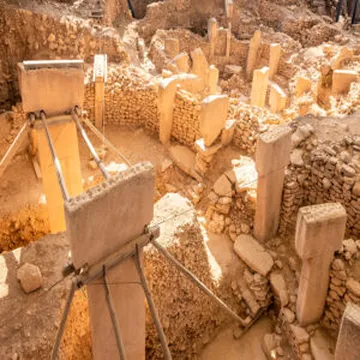
Göbekli Tepe in modern-day Turkey is presented as a site that contradicts the standard model of history due to its extreme age and sophistication. Dating back exactly 11,600 years, the site features T-shaped megalithic pillars and advanced astronomical alignments created by a society supposedly composed only of hunter-gatherers. The sudden appearance of both monumental architecture and agriculture suggests a transfer of technology from survivors of a lost civilization rather than a spontaneous local invention.

Graham Hancock | Magicians of the Gods, Atlantis, & The Ancient Impacts
• 52:49 - 54:59

Graham Hancock | Magicians of the Gods, Atlantis, & The Ancient Impacts

Klaus Schmidt, Archaeological Prejudices, Discovery Timeline

The history of the excavation at Göbekli Tepe reveals how academic prejudice delayed the site's recognition for decades. American archaeologists in the 1950s dismissed the visible tops of the pillars as part of a recent Byzantine cemetery, leaving the site untouched until Klaus Schmidt of the German Archaeological Institute began excavations in the 1990s. This timing is noted for its synchronicity, as the site was finally decoded during the very astronomical window it appears to reference.