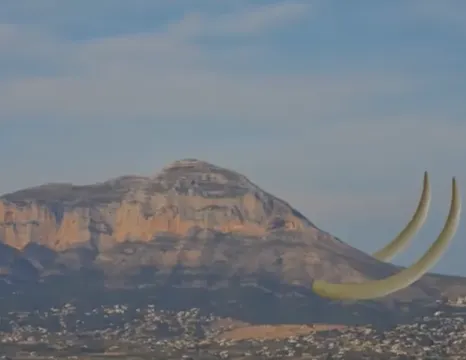
08:15 I love it. That's a great intro and the speed in which this stuff can happen is, I think one of the most compelling elements that we will get to but another thing I found compelling is that it's not just a profile of a mountain that looks like you like profile of a face, or in the case of your multi-part documentary. A huge three mile long Titan mammoth or some vertebrate type of thing. It's not just the shape of it that looks kind of like a mammoth. It is actually that there seems to be caves and cavities inside
08:51 this particular mountain at least that match where the eye socket would be or where the ear canal would be. So it's not just the outside, you have to look at this thing and say Okay, here's what we're looking at. It looks like it could be a mammoth or like a giant dog laying down or some kind of four-legged creature and then okay that's one thing but then going inside the mountain and having cavities where organs would be and having that match up now we're cooking with gas now we're talking about a true mystery and that's something I hoped you could elaborate on if you have
09:29 easy to access photos of that, it would be probably pretty compelling for people to see. Sure yeah I mean you're talking about the concept of pareidolia which is this idea that we recognize a face in something or or a shape and it's not actually there And there are loads and loads of photographs circulating from the people who were interested in these subjects, titans or gigantism in general. Basically they're presenting these things as if it's just proof as a fact that these things once existed And I was highly skeptical early on. I come from an academic background, I have two college degrees, I did a master's in chiropractic and part of that was a master's thesis. And so we learned a lot about the scientific method and how to properly apply it. So I was seeing these videos and photographs and the claims being made and I was like
10:24 Okay, it's a fun idea but is there truth to it and where's the follow-up? Usually it's just one photograph from one angle. They're not accounting for the possibility that could be shadows that are shaping the look, foliage, snow... That sort of thing. I originally came across these ideas through a few different videos one was one called geology revived by a channel called wakey wakey that no longer exists and he was just pulling at the threads of geology and challenging the cornerstones of some of the major beliefs about petrogenesis and how stone comes about. Then there was a video called No Forests on Earth or no forests on flat earth that was looking at the giant tree idea, looking at these different tabletop mountains that exist around the world
11:17 places like Devil's Tower in Wyoming and, you know, suggesting the possibility that these were once great trees. And we're talking about things that were an order of magnitude larger than the largest trees on Earth right now which would be your sequoias. So I thought it was fascinating but it wasn't something that I was going to jump into and study more in depth but another channel Jay Dreamers, he was talking about this subject Titans and different things that had to do with eschatology and cataclysm and different periods in time when there were great dyings off.
11:56 And even in the mainstream geological model, they talk about that. They say there were five great cataclysms the most recent having been the asteroid strike that supposedly wiped out the dinosaurs and several before that so we can see in the fossil record that there are all kinds of species that once existed but no longer do but J-Dreamers was really synthesizing a lot of these different ideas in a way that was pretty palatable and made sense to me But I still wasn't completely convinced. It was really the penny drop for me because there were some different sites that he showed images of like an island just off the coast of Maui and another place in Iceland that looked very much like elephants, not just from one angle but from multiple angles. And for me that's a key when it comes to pareidolia if you're looking at something from one angle well what what's it going to look like if you if you're looking at it from 90 degrees
12:55 rotation? Is it still going to look like what you're thinking, is it going to look at if you're looking in 3D and your tilting and your zooming around does it does it look lik that from all these different angles. And I would say the vast majority of what's being shared out there doesn't. So that was an annoyance for me because of the steadfast claims that were being made, so once i saw his video that was when when I just kind of went wait a minute because there is this mountain in the town that I live here on the Costa Blanca in Spain called Mont Gau and it's also known affectionately as the elephant here. And the reason is because it looks a heck of a lot like an elephant, not just the overall shape but like you mentioned there's a cave right where an eye socket should be
13:42 And that cave isn't just an opening. It's actually shaped like an eye socket, like we have this eyebrow bridge and if this were a vertebrate or specifically like a mammoth or elephant type creature theirs is far more pronounced and it has that feature. So I'd been up at that cave many times on my own just hiking and checking it out and never contemplated the possibility of that I might be walking on an ancient Titan But I thought, what a fun flight of fancy. This is an interesting intellectual exercise let's just see what comes about so i got on Google Earth and started looking at this thing which was pretty high resolution because it was in a nice tourist area so I was able to get a lot of detail with Google Earth and tilt and rotate
14:31 And what I found after about an hour of looking is that there were about eight, nine, 10 different macro anatomical features that matched up perfectly with anatomy and we're where they should be. And so I was like, That's already a pretty big number. It is one thing if you are looking at something from one angle, it is another thing if you're looking from an angle that has an eye socket and there is quarter moon discoloration. The whole mountain is limestone so it is grey or white and everywhere the rock is broken away
15:08 it's actually reddish underneath. And in fact, when you do break away rock, it exposes these channels that are filled with a red earth and oftentimes iron ore and quartz crystal. And so we can get to that later but basically it's in alignment with the composition of a bone, which I hadn't really hit on until later on when i started gathering information about the mountain. But there's this quarter moon cutout that looks like an ear was removed and it's in the exact place that an ear should be So, and then if you think the head and the shoulders there's it curves in on both sides right where the head would meet the shoulders. Each one of these is a point on a list of features right? And the longer that list gets the more bizarre it is because it's one thing if it looks like something from a certain angle It's another thing If there are 10 or 20 or 30 or 50 things that line up
16:09 seven years since I started this process of examining the mountain and looking at it, I've accumulated over 50 anatomical and histological correlations. So I've been in the caves, I've spelunked them, I photographed them, I got video, I have taken microscopy to it you know a 1000x microscope really done a pretty thorough in-depth investigation into this. And so when you think about games of chance and rolling dice, and what are the odds of rolling double sixes? What are the odds of rolling it three times in a row or six or 10 times in a row that number gets astronomical very quickly. And it's the same thing when you're looking at a list of features that are highly specific. And I can show people later on what I mean by highly specific. The greater that list grows
16:59 the more likely there's some sort of a pattern at work. Whether we're in some kind of matrix that is morphing to accommodate my examinations, or if this is the Twilight Zone I don't know but the more I got into it, the more surreal it became. But I went in very level-headed and After that initial foray into the idea on Google Earth, I got out my anatomy books from school and started looking more in depth at the anatomy of the eye socket. Because I remembered from school that the eye socket is very detailed. It's comprised of seven different bones that make up where the eyeball sits.
17:42 And all of those bones have meeting points that are known as sutures. And then there are also fissures, which are gaps between those bones where things like the optic nerve and blood vessels are traveling right so I had a list of things that I would expect to find if there was any truth to this harebrained idea. And I went up to do a little reconnaissance and on that first trip, up to the eye after looking at it through Titanology eyes, I found an additional 10 features within the cave So already we're up to about 20. And that's a big number, so the question is you know to the skeptic how big does that number have to get before you start to consider something of possibility? When does it become a
18:32 plausibility, when is it a probability or when is it just a fact? And for a lot of people that number's far lower than it is for me because I'm skeptical of my own work as well. But there are other things that have come along Uh, since then that I'm far more confident about than the mountain. Which is surprising consider how much data I accumulated perfect. Well, that is a great summary and I think I'll probably just have my editor play the trailer during the talking that you were doing because I feel like the trailer on mute really does a good job of showing the cavities as we're talking about them and stuff because we're already 25 minutes in there's so many things I want to add