

Topic: Walnuts

Walnuts comes up in 3 chapters across 3 episodes of The Higherside Chats Free Show, from September 2024 to June 2026.

September 2024 June 2026

Related topics

Todd Elliott | The Cunning Farmer: Magical Timing, Ritual Practice, & Land Spirits
• 49:38 - 52:03

Todd Elliott | The Cunning Farmer: Magical Timing, Ritual Practice, & Land Spirits

Doctrine of Signatures and Planetary Herb Gathering

The hosts discuss the "Doctrine of Signatures," the ancient belief that the physical appearance of a plant indicates its medicinal or magical use, such as walnuts benefiting the brain. Elliott explains that plants have both a species mind and individual souls. He emphasizes gathering herbs during specific planetary hours, such as harvesting henbane on a Saturday at sunrise, to enhance their spiritual potency.
Dr. Barre Lando | The Doctrine of Signatures, Toroidal Earth, Mt. Shasta, & The Royal Tetons
• 2:32 - 7:25

Dr. Barre Lando | The Doctrine of Signatures, Toroidal Earth, Mt. Shasta, & The Royal Tetons

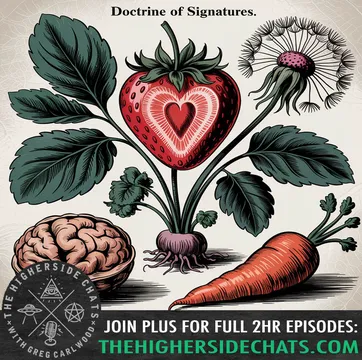
Doctrine of Signatures, Plant Resemblance to Human Organs

Dr. Bear Lando defines the Doctrine of Signatures as an acknowledgment of common patterns running throughout nature where plant characteristics mimic human ailments or anatomy. Examples provided include carrots resembling the human eye to support vision, walnuts mimicking the brain cortex for cognitive health, and lungwort treating respiratory issues. This framework serves as an introductory "cheat code" for understanding herbalism and the intelligent design behind the plant kingdom.

doctrine of signatureshomeopathybeta carotenewalnutslungwort
Mark Shepard | Restoration Agriculture, Wild Profit, & Nature’s Intelligence
• 36:01 - 42:04

Mark Shepard | Restoration Agriculture, Wild Profit, & Nature’s Intelligence

Agricultural Subsidies, Land Equivalent Ratio and Polyculture Yields

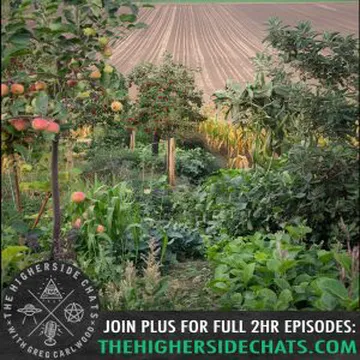
The discussion critiques the US agricultural system as a welfare-dependent industry propped up by federal subsidies. Shepard introduces the Land Equivalent Ratio (LER), demonstrating that planting multiple species on the same acre—such as corn, walnuts, squash, and chestnuts—results in higher total biomass and photosynthetic yield than monocropping. This polyculture approach reduces input costs while diversifying revenue streams.

subsidiesland equivalent ratiopolycultureblack walnutsphotosynthesisbiomass