

Land Ownership, Autonomy, and the Artificial Land Crunch
The discussion centers on the systematic removal of land ownership from individuals, shifting autonomy toward corporations and rental rackets. Christopher Topher Gardner emphasizes that the current land crunch is artificial and can be overcome through responsibility and stewardship rather than just capital. He shares a personal anecdote about acquiring land in Missouri through a work-lease agreement after being scammed, highlighting that work ethic often opens doors to ownership.
land ownership· autonomy· corporatocracy· missouri· stewardship· work ethic
00:06 It's the end of the world as we know it, but I feel fine. From the Sunshine State, I'm Greg Carlwood. And there's a real argument that the puppet masters of the power pyramid maintain their power primarily by managing the public's perception on resources and instilling the belief that their management and distribution skills are needed no matter how badly they execute because the alternative could be much worse. And a crucial component of engineering that mindset is producing sufficient propaganda that says industrialized corporatocracy produces abundance in a naturally scarce, harsh, and unforgiving world. It doesn't seem to be true, but we've been herded into small apartments and concrete cities, HOA dictatorships in a rental racket.
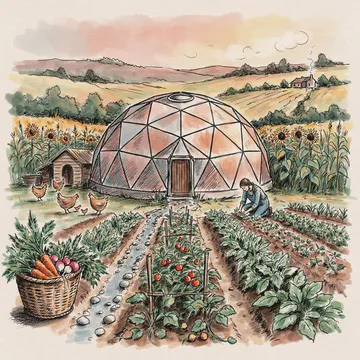
00:48 So that even if we had the hunch, our ability to even test it is quite limited today. I've come to believe that one of the primary battlegrounds is land ownership and the autonomy to plant your own ever-yielding fruit trees and healing herbs, care for your own chickens, and experiment with a wide range of esoteric and naturalistic technologies from electroculture and cloud-busting organite to vortexing structured water that comes right from the earth and the supercharged benefits of properly cultivated soil. Well, today we're talking to someone who's done all this and more, and that's Christopher Topher Gardner, host of the Biocharisma podcast on a 10-acre plot in rural Missouri.
01:27 He's put into practice much of the wisdom he gained from many of the bright minds we talk about around here, Nikola Tesla, Wilhelm Reich, Victor Schauberger, and many more. His dedication to healing the intentionally depleted and neglected soil resulted in forming his own supercharged biochar company, Black Gold Biochar, where he produces 400 tons a month, aligning the modern need for an income with the needs of the earth and those living on it. He's also mastered the art of constructing several types of dome structures, having built them all around the world, from tropical eco-domes or techodomes to coral domes and several other really impressive structures that conventional particle board frame homes would struggle to compete with on an even playing field.
02:09 And if that wasn't enough, he's also a skilled body worker and massage therapist, having trained in several different modalities after his football kicker career left his body in need of repair. An impressive guy on many fronts, the big bad biochar alchemist, nature wizard, and true master builder. Topher, welcome to THC. Greg, it's my pleasure to be here. Yeah, man, this is going to be a good one. I think we take inspiration from a lot of the same people and mindsets, but you are a lot further downfield in making these things part of your everyday life and your income. The more I've learned, the more impressed I have become and the more behind I feel.
02:47 It's impressive because as I tried to get at in that intro, one of the biggest attack vectors on us, one we don't even realize or we didn't realize until it was too late for a lot of our families who did own land like two or three generations ago, is the taking away of that land, wouldn't you say? Definitely. Definitely. The land crunch is a completely artificial thing. And that coupled with the true education crunch and skill crunch, you end up having, you know, people that are bereft of any land or any skills to work it.
03:24 Amen. And it is just crazy because so many people, anytime there's a show like this about what you can do with land and how it's kind of the only thing we can do, we can go over the Freemasons and the Bilderbergs and the Trilateral Commission and the Skull and Bones once again, if we must. But what are you going to do with that information? This is stuff that if you can just get over that economic hump of getting past that land crunch, as you put it, you can actually do a lot of amazing things. And as foreign as it might seem to a lot of people listening who feel maybe economically behind, if you just go a couple of generations like your grandfather, your great-grandfather, I grew up in Missouri, as you know, and like I have several friends that go out to the family land.
04:10 There's nothing on it, but they just take trips out to the rural areas way outside of the city. And oh, here's grandpa's 30 acres. We just run around on the land and fish, maybe. It wasn't so long ago that people owned land, and now it's mainly corporations who rent it back to us. Well, kind of. I mean, I still see tons of land out there. And I tell people that don't have any money to buy land. I tell them just be very responsible and make yourself available for either being like a landlord or stewarding land. Because one thing that's lacking out there is people that are actually responsible.
04:52 I had moved to an area of the world where when I got there, I got scammed out of all of my money and I literally didn't have money for rent. And just because I was responsible and I was married, and like I just showed up when I said I would show up, that worked into a work-type lease deal for the land. And then I ended up owning that land. I didn't have any money down, but what I did have was a work ethic and responsibility. And when you combine work ethic and responsibility, you would be amazed how many doors open up for you, especially with land ownership. Yeah, they say it's hard to find good people to do good work. So just be one of those good people and things come back to you.